
Last Updated: November 18, 2026
Quick Summary
To learn how to write copy for high converting funnels, map each funnel stage before you write a word: top of funnel earns attention, middle builds belief, and bottom removes risk. Match your message to buyer awareness at every stage, then draft one message per stage.
- Map each stage first: opt-in, sales page, checkout, and upsell, then note the one action you want at each.
- A cold visitor needs a problem named, while a ready buyer needs a reason to act now.
- Run a copy research sprint: mine voice-of-customer language, list objections, and map proof to each claim.
- Test the headline and value proposition first because they drive the most change.
- Set a minimum sample per variant and let tests run a full week before calling a winner.
Table of Contents
- Map Each Funnel Stage Before You Write a Word
- Sales Funnel Copy Examples That Show the Stage-by-Stage Difference
- Conversion Copywriting Best Practices for Every Page
- Sales Funnel Copywriting Templates You Can Adapt
- Build a Sales Funnel Email Sequence That Nurtures and Converts
- Test, Measure, and Fix Weak Copy Before You Scale Traffic
- Build Your Funnel Copy Inside Builderall
- Frequently Asked Questions
Map Each Funnel Stage Before You Write a Word
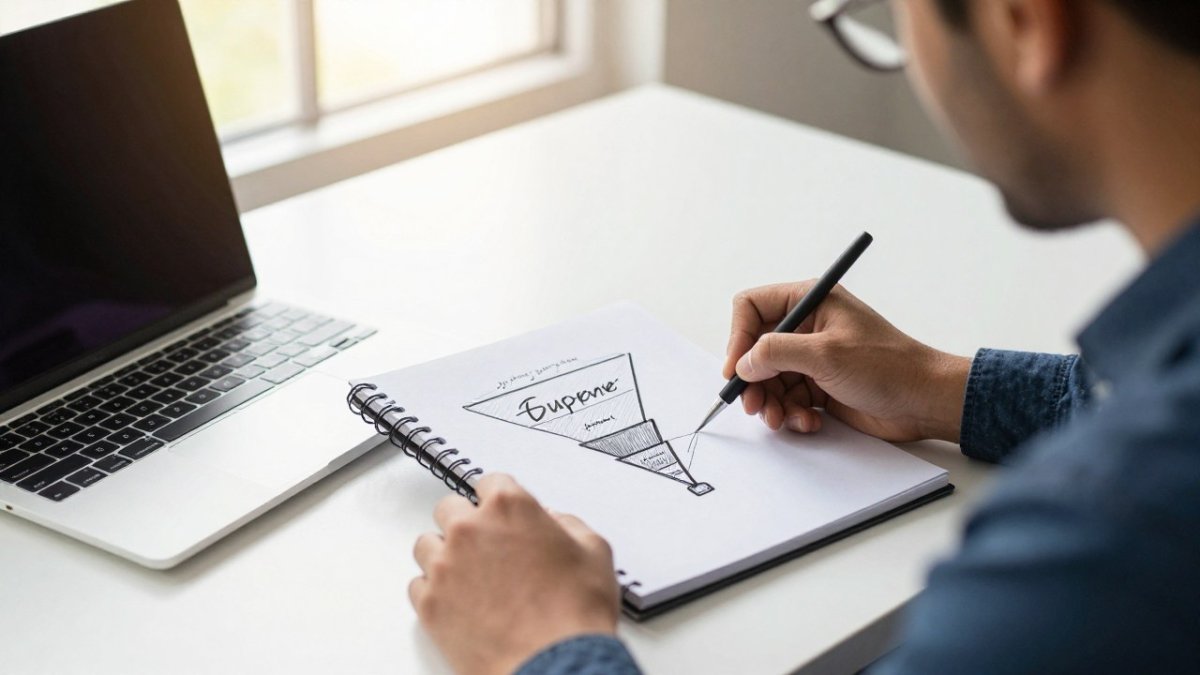
Copy fails when it skips a step. If you want to know how to write copy for high converting funnels, start by mapping every stage before you type a single headline.
Writers who map first tend to move faster and avoid rewriting everything later. For a deeper walkthrough of designing high-converting sales funnels for beginners, see the full guide.
Here is a simple mapping method we recommend:
- List each stage: opt-in, sales page, checkout, upsell.
- Write the one action you want at each stage.
- Note what the visitor already knows when they arrive.
- Match the message to that knowledge level.
Match Copy to Buyer Awareness at Every Stage
Buyer awareness decides your opening line. A cold visitor needs a problem named. A warm visitor needs proof. A ready buyer needs a reason to act now.
Map awareness to copy like this:
| Awareness Level | What They Know | Copy Job |
|---|---|---|
| Unaware | Nothing yet | Name the pain |
| Problem-aware | They feel the problem | Show the outcome |
| Solution-aware | They know options exist | Prove your approach |
| Product-aware | They know you | Handle objections |
| Ready | They want to buy | Give a clear CTA |
Most guides skip this step. That is a mistake. A headline written for a ready buyer confuses a cold visitor, and a soft intro bores someone who is already sold.
Sales Funnel Copy Examples That Show the Stage-by-Stage Difference
The fastest way to learn funnel copy is to see the same offer written three ways. Watch how the message shifts as the visitor moves down.
Opt-in page, cold traffic:
“Still guessing which email subject lines get opened? Grab the 12-line swipe file we use before every launch.”
Sales page, solution-aware:
“You have tried the swipe files. Here is the full system that turns those lines into a sequence that sells.”
Checkout page, ready buyer:
“You are one click from instant access. Your templates unlock the moment you join.”
Same product. If you want a concrete build to see these principles applied, our guide on how to build a simple sales page for digital downloads walks through the structure step by step.
Conversion Copywriting Best Practices for Every Page
Most guides hand you a list of rules and stop. The rules are fine, but they do not tell you where the words come from or how to adapt them to each page type. This section closes that gap with a repeatable research-to-draft workflow, then shows how the same principles change by page and by business model.
Run a Copy Research Sprint Before You Draft
Strong funnel copy is assembled, not invented. Before you write a headline, spend a focused block gathering raw material. A practical sequence most practitioners find works:
- Mine voice-of-customer language. Pull exact phrases from support tickets, sales call notes, reviews, and community threads. Copy the sentences customers use to describe the problem, not your internal labels for it.
- List objections in the customer’s words. Group them by stage: price doubts belong near checkout, fit doubts belong on the sales page, effort doubts belong on the opt-in.
- Map proof to each claim. For every promise you plan to make, note the evidence you can show: a named testimonial, a documented result, a demo, a guarantee term. If you cannot substantiate a claim, cut it or soften it.
- Draft one message per stage. Write the single action and the single belief shift for that page before writing body copy.
Watch out: skipping the proof-mapping step is how vague claims like “thousands of happy customers” end up on the page. One specific, named result beats ten generic quotes, and it is easier to defend if a claim is ever questioned.
Adapt the Same Principles by Page Type
The best practices do not change, but their emphasis does. Use this as a working checklist:
- Opt-in page: Lead with the outcome the lead magnet delivers, name the audience, and keep the form short. The CTA should state what they get, not just “Subscribe.”
- Sales page: Open with the problem in the reader’s words, then move through outcome, mechanism, proof, offer, and risk reversal. Put a CTA after the proof block and repeat it near the price.
- Checkout page: Remove friction, restate what they are buying, show the guarantee, and keep the CTA specific (“Complete my order”). Every extra field or link is a place to lose the sale.
Adapt by Business Model and Traffic Source
Generic advice fails when the offer type changes. A few adaptations worth building into your process:
- Ecommerce: Product pages carry the persuasion load. Lead with the outcome and the use case, put shipping and return terms near the buy button, and use reviews as stage-matched proof.
- Services: The sales page sells the engagement, not a download. Replace feature lists with process, timeline, and who it is for. Case studies do the work testimonials do for products.
- Digital products: The opt-in and sales page must overcome “will this actually help me?” Show the inside of the product, a sample lesson, or a short walkthrough.
Keep Copy Readable and Accessible
Readability is a conversion lever, not a nicety. Write short sentences, use plain words, and break long blocks with subheads. On mobile, front-load the outcome and the CTA because the first screen is all many visitors see. Use descriptive link text and button labels, keep contrast strong, and make sure form fields have visible labels. Accessible pages are easier to use for everyone, and they reduce the friction that quietly kills conversion.
A Short Checklist Before You Publish
- Lead with the outcome, not the feature.
- Keep one idea per section.
- Put the CTA above the fold and repeat it lower.
A common mistake is stuffing every benefit onto one page. That buries the CTA and stalls the click. Pick the single action for that page and write everything toward it.
Sales Funnel Copywriting Templates You Can Adapt
You do not need to start from a blank page. These sales funnel copywriting templates give you a working structure you can fill in fast.
Template 1: Problem-Agitate-Solve (PAS)
- Problem: “You publish posts and hear crickets.”
- Agitate: “Every silent launch costs you time and momentum.”
- Solve: “Here is the sequence that gets replies.”
Template 2: Attention-Interest-Desire-Action (AIDA)
- Attention: A bold claim or question.
- Interest: A specific detail that proves you understand.
- Desire: The outcome, painted clearly.
Template 3: Before-After-Bridge (BAB)
- Before: The reader’s current struggle.
- After: Life once the problem is solved.
- Bridge: Your offer as the path between them.
Fill each slot with one or two sentences. Keep it tight. Then test the headline first, because it drives the most change.
Build a Sales Funnel Email Sequence That Nurtures and Converts
Email is where most funnels earn their money. A good sales funnel email sequence warms the lead, builds belief, and asks for the sale without feeling pushy.
Here is a five-email structure we recommend:
- Welcome: Deliver the lead magnet and set expectations.
- Story: Share the problem and how you solved it.
- Proof: Show a result or testimonial.
- Offer: Present the product with a clear CTA.
- Close: Handle the top objection and add urgency.
Keep each email to one idea and one link. If you want the full setup behind this sequence, our step-by-step guide on how to set up email automation for beginners covers the triggers and timing.
A common mistake is sending five hard pitches in a row. Mix value with the ask. Readers who trust you open the offer email.
Test, Measure, and Fix Weak Copy Before You Scale Traffic
Traffic exposes weak copy fast, but only if you have a plan for reading the signal. Most guides stop at “run an A/B test.” This section gives you a testing plan with metrics, sample-size cautions, and decision rules so you know when a result is real and what to do next.
Define the Metric Before You Change the Copy
Every page has one primary metric and a few guardrail metrics. Write them down before the test starts so you cannot rationalize a loss later.
- Opt-in page: Primary is opt-in rate. Guardrails are form completion rate and unsubscribe rate on the first email.
- Sales page: Primary is conversion rate. Guardrails are refund rate and average order value.
- Checkout page: Primary is completed orders. Guardrails are cart abandonment and support tickets.
Run One Test at a Time, in Priority Order
Change one variable per test so you know what moved the number. Test in order of expected impact:
- Headline and value proposition. These drive the most change because they set the frame for everything below.
- Offer and risk reversal. Guarantee terms, trial length, and bonus framing often move conversion more than button color ever will.
- CTA wording and placement. Specific labels beat generic ones, and a repeated CTA near the price catches readers who scroll before deciding.
- Proof placement. Move testimonials and case studies next to the point of doubt.
- Form length and fields. Fewer fields usually lift completion, but only test this if lead quality holds.
Watch out: testing three things at once tells you nothing. If the variant wins, you will not know which change did it, and you may ship a change that hurt while another helped.
Respect Sample Size Before You Call a Winner
Small samples produce false winners. A common pattern is a variant that looks ahead after a few dozen visitors and reverses once traffic scales. Before you decide:
- Set a minimum sample per variant based on your baseline conversion rate and the lift you want to detect. A statistician or a reputable sample-size calculator can give you the number; do not guess.
- Let the test run long enough to cover a full week, so day-of-week behavior does not skew the result.
- Do not peek and stop early because a variant is ahead. That is how noise becomes a decision.
Use Decision Rules, Not Gut Feel
Write the rule before the test starts. A workable set:
- Ship the variant if it beats control on the primary metric and does not worsen any guardrail metric beyond a threshold you set in advance.
- Keep control if the variant loses or ties on the primary metric.
- Investigate if the primary metric improves but a guardrail worsens. The win may not be worth the cost.
Fix the Page Before You Blame the Traffic
If a page underperforms, check the basics before spending more on ads: message match between the ad and the page, load speed on mobile, form friction, and whether the CTA is visible without scrolling. If a form underperforms, our breakdown of why landing page forms fail to capture leads shows the usual culprits. Small fixes here save big money later, and they are cheaper than scaling traffic onto a page that cannot convert.
Build Your Funnel Copy Inside Builderall
Writing strong funnel copy is only part of the job. You also need to get it live.
Here is how we would use it:
- Draft each stage in the drag-and-drop page builder.
- Drop the opt-in, sales, and checkout pages into one funnel.
- Connect the email sequence with the built-in email tools.
No coding. If you want the bigger picture of how the platform simplifies this work, see the seven ways Builderall simplifies digital marketing.
The copy does the persuading. The platform just gets out of your way.
Funnel copy is not about writing more. It is about writing the right words for the right stage.
Frequently Asked Questions
How do you write copy for a sales funnel?
Start by mapping each stage and the buyer’s awareness level at that point. Write top-of-funnel copy around the problem, middle-of-funnel copy around the solution and proof, and bottom-of-funnel copy around the offer and risk reversal. Keep one message per page, lead with the outcome, and place a single clear call to action above the fold and again after each proof block. Then test headlines and CTAs first, since they move conversion fastest.
What makes sales funnel copy convert?
Specificity and relevance. Copy that names the exact problem, quantifies the outcome, and answers the reader’s next objection converts better than clever wording. Strong funnel copy also matches the traffic source: a Meta ad promising a free checklist should land on a page about that checklist, not a generic homepage. Clear headlines, visible trust signals like testimonials, and a low-friction call to action do most of the work.
How long should sales funnel copy be?
Long enough to answer every objection the price point creates. A free lead magnet opt-in page often converts with 100 to 200 words, while a higher-priced offer may need 1,500 words or more of proof, FAQs, and guarantees. Test both a short and a long version of your sales page. Length is not the goal; completeness is. Cut any sentence that does not build desire, prove a claim, or remove friction.
How can you test and improve funnel copy?
Test one variable at a time, starting with the headline, then the offer, then the call to action. Run each test until you have enough traffic for a meaningful result, and track opt-in rate, click-through rate, and conversion rate separately by stage. Use heatmaps and session recordings to see where readers stop scrolling. Small copy changes to headlines and CTAs usually produce the biggest gains before you rewrite whole pages.