
Table of Contents
- The Real Cost of a Sales Funnel for a Local Business
- Sales Funnel vs Booking Page: A Side-by-Side Comparison
- Pros and Cons of Sales Funnels for Local Businesses
- How Appointment Scheduling with Email Marketing Fits a Funnel
- Free Online Appointment Scheduling Tools That Support Follow-Up
- Combining Appointment Booking and Email Marketing for Better ROI
- Google Calendar Appointment Scheduling and Funnel Automation
- Building Your First Local Funnel with Builderall
- Frequently Asked Questions
Last Updated: November 9, 2026
The Real Cost of a Sales Funnel for a Local Business
Whether a sales funnel is worth it for local businesses comes down to one question: does the funnel earn more than it costs you in time, tools, and missed phone calls? For most local service businesses, the honest answer is “sometimes, and only if it’s built around booking.”
Here’s the problem with the standard advice. Most funnel tutorials are written for online course sellers and digital product creators, where the entire sale happens on a screen. A local business doesn’t work that way. Your customer usually wants to talk to a person, confirm a time, and know you’ll actually show up. A funnel that ignores booking is a lead collection machine with a leaky bucket at the end. A funnel that captures leads without a clear handoff to the calendar often leaves those leads unconverted.
The real costs break down into three buckets:
- Tool costs: a funnel builder, an email platform, and a scheduling app, often billed separately
- Time costs: building pages, writing follow-up sequences, testing forms
- Opportunity costs: the leads that go cold while you’re still assembling the pieces
That third one hurts most. A local business lives on response speed. A funnel that captures a lead on Tuesday and follows up on Friday has already lost to the competitor who called back in an hour.
Sales Funnel vs Booking Page: A Side-by-Side Comparison
A booking page can suit many local service businesses because it lets prospects confirm an appointment quickly. A funnel wins when you need to educate a prospect across several touchpoints before they’re ready to commit.
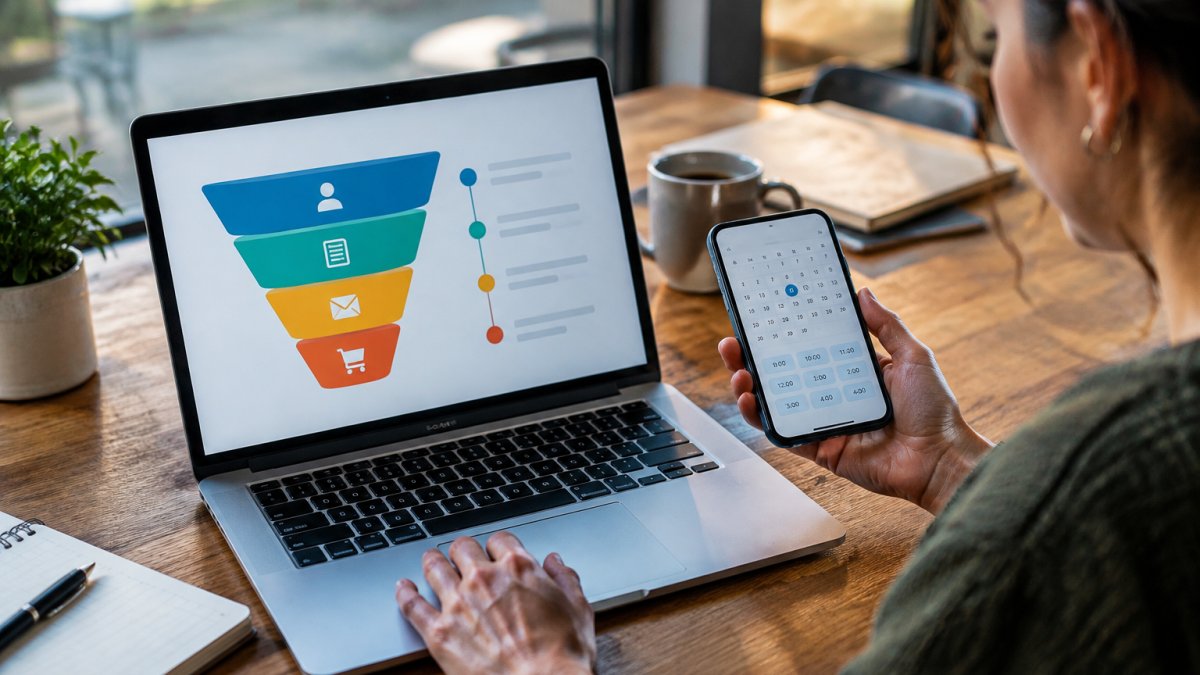
The distinction matters more than most guides admit. A funnel is a sequence: landing page, opt-in, email nurture, offer, conversion. A booking page is a single destination: service, time slot, confirmation. One builds a relationship over days. The other closes the loop in minutes.
| Factor | Sales Funnel | Booking Page |
|---|---|---|
| Time to first appointment | Days to weeks | Minutes |
| Setup complexity | Multiple pages and emails | One page, one calendar |
| Best for | Considered purchases, education-heavy offers | Service calls, consultations, appointments |
| Lead capture | Form opt-in | Direct booking with contact details |
| Follow-up required | Yes, heavy | Light reminder emails |
| Cost to run | Funnel tool plus email tool | Often one integrated tool |
If your customer’s decision is “I need this done soon,” the booking page is the shorter path. If your customer needs to understand why they need it, the funnel earns its keep.
For a look at what a clean local booking journey actually looks like in practice, see how services, contact details, and next available appointments sit in one flow.
Pros and Cons of Sales Funnels for Local Businesses
The pros are real: funnels capture leads you’d otherwise lose, they automate follow-up so you’re not chasing every inquiry manually, and they build a list you own instead of renting attention from ads. A funnel also forces you to think through your offer, which many local businesses never do.
The cons are just as real, and most guides skip them.
- Overkill for simple services: if you cut hair or fix furnaces, a five-step nurture sequence is friction, not value
- Maintenance debt: every page, email, and automation needs updating when your hours or prices change
- Wrong-fit leads: a funnel will happily collect prospects you can’t serve or can’t serve profitably, as MarketingSherpa’s case-study summary on saying no to customers points out
- The complexity trap: a funnel can become an overcomplicated way to describe something simple, a point Circe Creates makes in arguing against funnel worship
Our take: a funnel is worth it for a local business when the average customer value justifies the setup, and when the funnel ends in a booked appointment rather than an open-ended “thanks, we’ll be in touch.”
How Appointment Scheduling with Email Marketing Fits a Funnel
Appointment scheduling with email marketing is the piece that turns a funnel from a lead collector into a revenue engine. The funnel captures interest; the calendar converts it; the email sequence keeps it warm.
Here’s the sequence that works for local businesses:
- Capture the inquiry with a short form, name, contact, and what they need
- Route them straight to a booking calendar, not a thank-you page
- Confirm the appointment by email within minutes
- Remind them a day before, which cuts no-shows
- Follow up after the appointment with a review request or a rebooking link
That’s a funnel. It just happens to be a short one, and it ends where local business actually gets paid: on the calendar.
If you want the step-by-step version of wiring this together, our guide on automating appointment booking with email follow-up walks through the build.
Free Online Appointment Scheduling Tools That Support Follow-Up
Free online appointment scheduling tools can be a reasonable starting point, but free plans often limit follow-up features. Check each tool’s plan details before you commit.
What to check before you commit to a free scheduler:
- Does it send automatic reminder emails, or only confirmations?
- Can it collect intake questions so you’re prepared before the appointment?
- Does it sync both ways with your calendar, or only one?
- Can you export your client list if you outgrow it?
The free option is fine for testing whether booking even helps your business. Once you know it does, the follow-up automation is where the return shows up. For a hands-on comparison of tools that include follow-up features, see our review of online appointment booking software.
Combining Appointment Booking and Email Marketing for Better ROI
Appointment booking and email marketing deliver better ROI together than either does alone. Booking captures the commitment; email marketing protects it and multiplies it.
Three places the combination pays off:
- No-show reduction: reminder emails sent before the appointment recover slots that would otherwise go empty
- Rebooking: a follow-up email with a one-click rebook link turns a single visit into a repeat customer
- Reactivation: a simple “we haven’t seen you in a while” sequence brings back lapsed clients at almost no cost
Watch out: treating booking and email as two separate systems can mean exporting lists and reconciling calendars by hand. Keeping them in one place makes follow-up easier to manage.
Google Calendar Appointment Scheduling and Funnel Automation
Google Calendar appointment scheduling can be an easy option for many local businesses because customers already use Google.
It is a booking tool rather than a funnel tool, so it does not run nurture sequences or lead scoring on its own. That’s fine if booking is all you need. If you want automation around the booking, you need a platform that connects the calendar to your email and pages. The practical setup is to let Google Calendar handle availability while your marketing platform handles everything before and after the appointment.
Building Your First Local Funnel with Builderall
Building your first local funnel is simpler when the pages, email, and booking calendar live in one platform instead of three. Builderall offers drag-and-drop page creation without code, email marketing through MailingBoss, and an integrated appointments calendar.
Here’s how you could build a local funnel in Builderall:
- Create a landing page with a clear offer and a short inquiry form
- Connect the form to the Booking app so inquiries land on a calendar
- Set a confirmation and reminder email in MailingBoss
- Add a post-appointment follow-up with a review request or rebook link
- Test the whole path yourself before sending any traffic to it
If you’re new to funnel design, start with our beginner guide to high-converting sales funnels before you build. When you’re ready to map and launch, you can build your first funnel from visual blueprints inside Builderall.
The real test of a funnel isn’t how sophisticated it looks. It’s whether it puts a confirmed appointment on your calendar and follows up without you remembering to. Builderall gives you the pages, the email automation, and the booking calendar in one place, so the handoff from inquiry to appointment doesn’t fall through the cracks. Get started with Builderall and turn your next inquiry into a booked appointment.
Frequently Asked Questions
Is a sales funnel worth it for a small local business?
It depends on your sales cycle. If customers book or buy in one step, a simple booking page with email follow-up usually costs less and converts faster. A sales funnel is worth it when you need to educate prospects, capture leads, and nurture them over days or weeks. Test a minimal funnel first, measure cost per booked appointment, and add steps only when they pay for themselves.
Do local businesses need a sales funnel or just a booking page?
Most local service businesses start with a booking page and win. A booking page removes friction and lets customers schedule instantly, while email confirmations and reminders reduce no-shows. Add a funnel layer when you have a lead magnet, a higher-ticket service, or a longer decision window. Your booking page can sit inside the funnel as the final step, so the two are not mutually exclusive.
How do you connect appointment scheduling with email marketing?
Use one platform that handles both. When a customer books, the system should trigger a confirmation email, a reminder before the appointment, and a follow-up after. Tag the contact by service type so future campaigns stay relevant.
What does a sales funnel look like for a service business?
A practical local funnel has three parts: a landing page that offers a clear outcome, a booking step that captures the appointment, and an email sequence that confirms, reminds, and follows up. Some businesses add a lead magnet or a quote request before the booking. Keep each step focused on one action and track how many visitors reach the calendar.